Errors on a garage door opener can appear without warning and stop daily life in its tracks. The Chamberlain B1381, a robust belt-drive unit, uses a start capacitor to give the motor the extra torque needed to lift a heavy door. When that capacitor fails, the opener may hum, refuse to start, or display a blinking error light. This guide walks through diagnosing and replacing the start capacitor, saving time and money on a service call.
What Is the Start Capacitor and Why Does It Fail on the Chamberlain B1381?
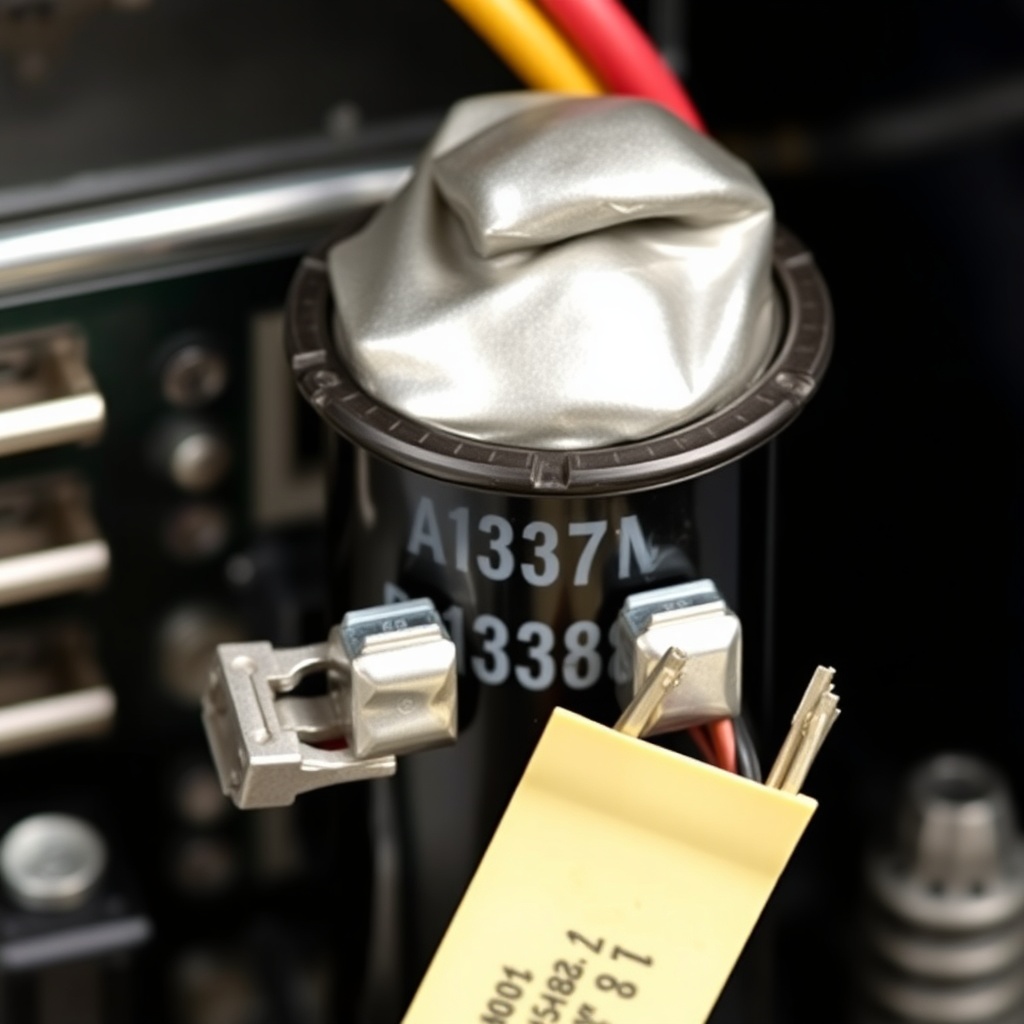
The start capacitor is a small cylindrical component that stores electrical energy and releases it during motor startup. In the Chamberlain B1381, it provides the initial jolt of power to rotate the motor armature. Over time, heat, voltage spikes, and age cause the capacitor’s internal electrolyte to dry out or the internal foil to short. When this happens, the opener motor will not start, or it will hum loudly without moving the door.
Symptoms of a failing start capacitor include:
- The motor emits a low hum but the door does not move.
- The opener’s lights flash rapidly (usually 5 or 6 flashes) to indicate a motor or power fault.
- The door moves very slowly or hesitates at startup.
- The opener trips the circuit breaker after a few seconds.
A visual inspection often reveals a bulged top, leaking oil, or a burnt smell. Capacitors are rated in microfarads (µF) and voltage (V). The Chamberlain B1381 typically uses a 30-40 µF, 240 VAC start capacitor, but one must check the exact rating printed on the side of the old unit before ordering a replacement.
Before proceeding, ensure the opener is disconnected from mains power. For detailed access steps, see the Chamberlain B1381 Opener Cover Removal: DIY Step-by-Step Guide.
How Do I Troubleshoot a Faulty Start Capacitor in the Chamberlain B1381?
Error codes are the first clue. On the Chamberlain B1381, the number of LED flashes on the back of the opener indicates the problem. A motor-related fault (capacitor or motor windings) often shows 5 or 6 flashes. Check the error code chart below:
| Flashes | Meaning | Likely Cause | Severity |
|---|---|---|---|
| 1 | Travel module fault | Limit switch or board issue | Moderate |
| 2 | Wire or sensor problem | Safety beam misalignment | Low |
| 5 | Motor fault | Start capacitor or motor windings | High |
| 6 | Motor overcurrent | Capacitor short, seized motor | Critical |
If the opener shows 5 or 6 flashes, the start capacitor is a prime suspect. Before replacing it, rule out other issues. Listen for the motor relay clicking. If you hear a click but no movement, the capacitor is likely not sending enough juice. If you hear nothing, the motor may be seized—check for Chamberlain B1381 Opener Motor Limit Switch Testing: DIY Troubleshooting to verify the switch isn’t interfering.
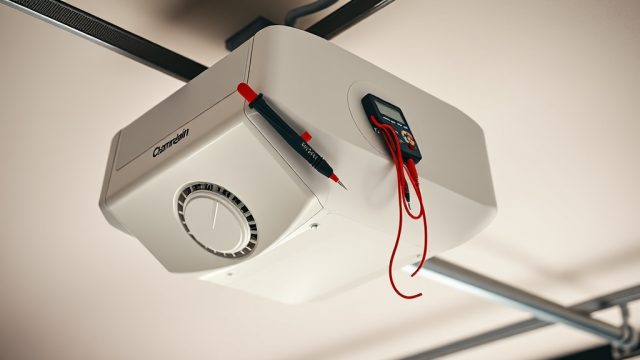
Another quick test: with power off, disconnect the capacitor wires and use a multimeter set to capacitance (µF) mode. A reading within ±10% of the printed value is good. A reading of zero or OL means the capacitor is dead. If you don’t have a capacitance meter, a visual inspection often suffices—a bulged top is a clear failure.
Where Can I Buy the Correct Start Capacitor for My Chamberlain B1381?
Replacement start capacitors for the Chamberlain B1381 are widely available. The correct part number is often CH851-193 or a generic 30 µF ±5% at 240 VAC. Prices vary:
- Amazon UK: £8.50 to £15.00 depending on brand and shipping.
- Garage door specialist sites: £12.00 to £18.00 for OEM equivalents.
- Local hardware stores: £10.00 to £20.00, though stock may be limited.
- eBay: £6.00 to £12.00 for used or generic options.
It is recommended to buy a capacitor rated for 250 VAC or higher, as the UK mains voltage is 230 VAC. A higher voltage rating adds safety margin. Always match the microfarad rating exactly—do not go higher or lower, as this can damage the motor.
Look for capacitors from reputable brands like Run Capacitor, CDE, or Supco. Avoid cheap no-name units that may have loose tolerances. If the old capacitor has a discharge resistor, ensure the replacement includes one, or add a 15 kΩ resistor across the terminals for safety.
Step-by-Step: How to Replace the Start Capacitor on a Chamberlain B1381
Replacing the start capacitor is a straightforward DIY task that takes about 20 minutes. Follow these steps carefully:
Tools needed:
- Flathead screwdriver or Torx T20 bit (cover screws)
- Needle-nose pliers (for wire connectors)
- Multimeter (optional, for verification)
- New start capacitor (30 µF, 240 VAC typical)
Procedure:
- Disconnect power: Unplug the opener or turn off the circuit breaker. Wait 5 minutes for the capacitor to discharge. For extra safety, short the capacitor terminals with a screwdriver (insulated handle) to bleed any residual charge.
- Remove the cover: Follow the Chamberlain B1381 Opener Cover Removal: DIY Step-by-Step Guide. Typically, this involves removing two screws at the back and sliding the cover forward.
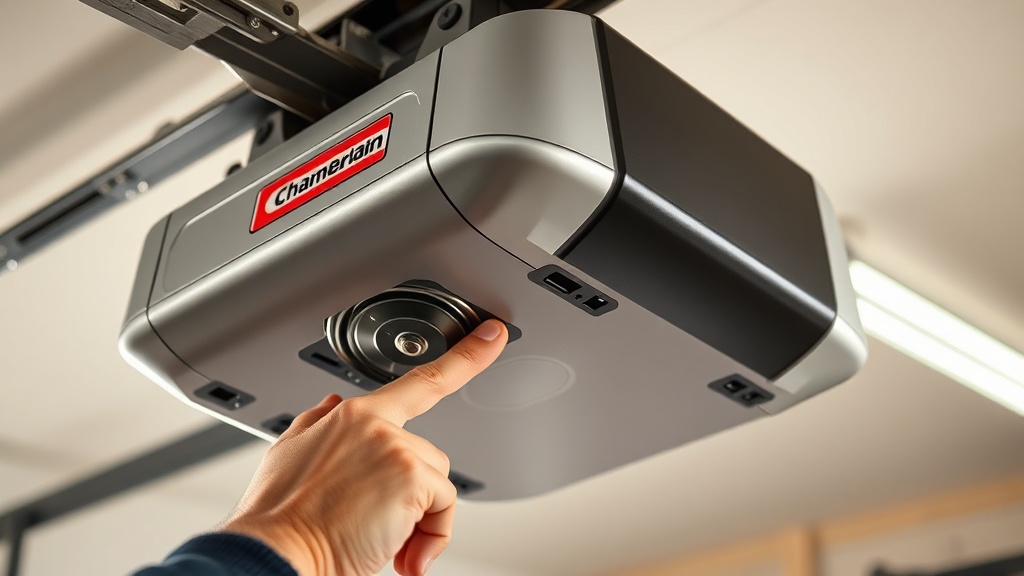
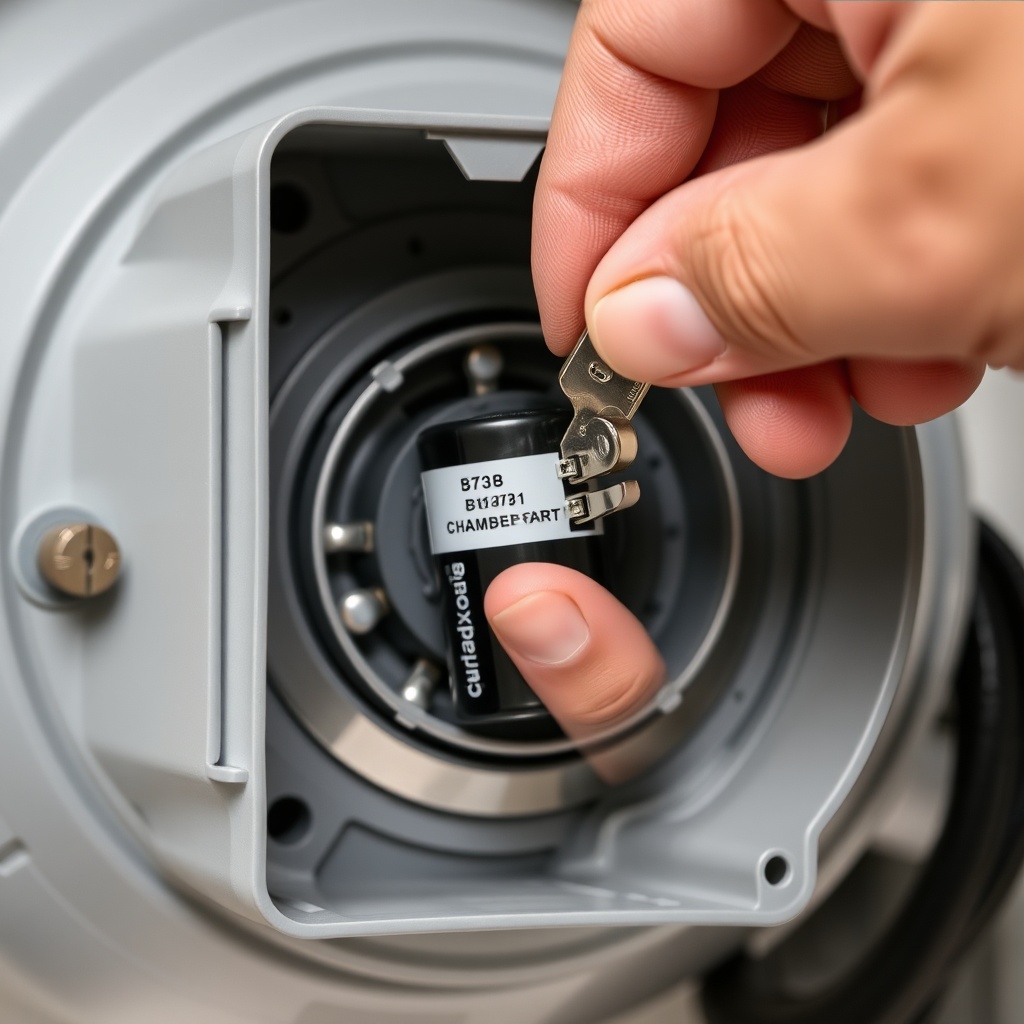
- Locate the capacitor: It is a small cylinder attached to the circuit board or motor housing, often near the motor relay. It has two wire terminals.
- Disconnect wires: Using pliers, gently pull the spade connectors off the capacitor terminals. Note the wire colours—usually black and white (or brown and blue). Take a photo for reference.
- Remove the old capacitor: If held by a metal clip or zip tie, loosen it. Slide the capacitor out. Dispose of it at a recycling centre—capacitors contain hazardous materials.
- Install the new capacitor: Place the new capacitor in the same orientation. Reattach the wires firmly. Ensure the connectors are tight to prevent arcing.
- Secure the capacitor: Reinstall the clip or zip tie. Make sure the capacitor does not touch any moving parts.
- Reassemble the cover: Slide the cover back and secure the screws.
- Restore power and test: Plug in the opener. Press the wall button or remote. The motor should start smoothly. If the opener runs but makes a clunking noise, check the chain tension: refer to Chamberlain B1381 Roller Chain Tension Adjustment: Step-by-Step Guide. If the error code persists, another component may be faulty—see the next section.
What Other Components Cause Similar Symptoms on the Chamberlain B1381?
If replacing the start capacitor does not resolve the 5- or 6-flash error, consider these related parts:
- Motor windings: A shorted or open winding mimics capacitor failure. Test with a multimeter (ohms). If the winding resistance is near zero or infinite, the motor requires replacement.
- Motor relay: A stuck or welded relay can prevent power from reaching the capacitor. Listen for a click when activating the opener. No click may indicate a relay or logic board fault.
- Travel module/limit switch: If the door stops mid-travel or the error code changes to 1 or 2 flashes, the limit switch may need recalibration. See Chamberlain B1381 Opener Motor Limit Switch Testing: DIY Troubleshooting Guide for a thorough walkthrough.
- Drive coupling: A stripped coupling can cause the motor to spin freely without moving the door. Inspect the coupling by looking through the top of the opener. For replacement steps, see Chamberlain B1381 Drive Coupling Replacement: Step-by-Step DIY Guide.
Intermittent issues may also be related to voltage fluctuations. Check the mains voltage at the outlet—UK homes run 230 VAC ±10%. A voltage drop under load can cause capacitor failure. If the power is stable and the capacitor is new, the logic board may be defective.
What Owners Say About the Chamberlain B1381 Start Capacitor Issue
Online forums and reviews reveal common experiences:
- “My B1381 hummed but wouldn’t lift the door. Replaced the £12 capacitor from Amazon and it’s been perfect for a year.” – Mike, Peterborough
- “The 5-flash error led me to the capacitor. I used a multimeter to confirm it was dead. The swap took 15 minutes.” – Sarah, Leeds
- “I tried a cheap capacitor from eBay—it only lasted three months. Spend the extra fiver for a name-brand unit.” – David, Cardiff
- “After capacitor replacement, I still had a 6-flash error. Turned out the drive coupling was stripped. Easy fix after reading the guide.” – James, Bristol
- “Chamberlain support said the capacitor is a common wear item after 3-5 years. Keep a spare handy.” – Helen, Edinburgh
Most owners agree that the capacitor is the first component to check when encountering motor-related error codes. Replacing it restores full function in the majority of cases, and the cost is minimal compared to a professional repair (which can run £80-£120 for labour plus parts).
Frequently Asked Questions
1. What microfarad rating does the Chamberlain B1381 start capacitor use?
The Chamberlain B1381 typically uses a 30 µF start capacitor rated at 240 VAC. Some variations may use 35 µF or 40 µF. Always check the exact rating printed on the side of the old capacitor before ordering a replacement. Using a different value can damage the motor.
2. Can I use a run capacitor instead of a start capacitor?
No. Start capacitors are designed for brief, high-torque bursts. Run capacitors are rated for continuous duty. Using a run capacitor will overheat and fail quickly. Always replace with a designated start capacitor of the correct µF and voltage.
3. How do I discharge the start capacitor safely?
Unplug the opener and wait 5 minutes. Then, using an insulated screwdriver, short the two terminals together. A small spark is normal. Alternatively, use a 15 kΩ, 5-watt resistor across the terminals for 30 seconds. Ensure the screwdriver handle is rubber-coated to avoid shock.
4. The opener still shows error code 5 after capacitor replacement. What next?
Check the motor windings with a multimeter. If the resistance between the motor wires reads zero or is open, the motor is defective. Also inspect the drive coupling—if it is stripped, the motor spins but the door does not move. Refer to the Chamberlain B1381 Drive Coupling Replacement: Step-by-Step DIY Guide.
5. Can a bad remote cause motor noise or startup failure?
No, the remote only sends a signal to the logic board. A faulty remote will not cause the motor to hum or fail to start. If the opener activates (relay clicks) but the motor hums, the capacitor or motor is at fault. For remote range issues, see Chamberlain B1381 Remote Range Issues: Diagnosis and Fixes.
6. How often should the start capacitor be replaced preventively?
Start capacitors typically last 3-7 years depending on usage and voltage quality. There is no scheduled replacement—replace only when symptoms appear. However, if your opener is over 5 years old and you notice slow starting, consider testing the capacitor proactively.